
Digital signature

Digital Signature

Digital signatures allow us to verify the author, date and time of signatures, authenticate the message contents. It also includes authentication function for additional capabilities.
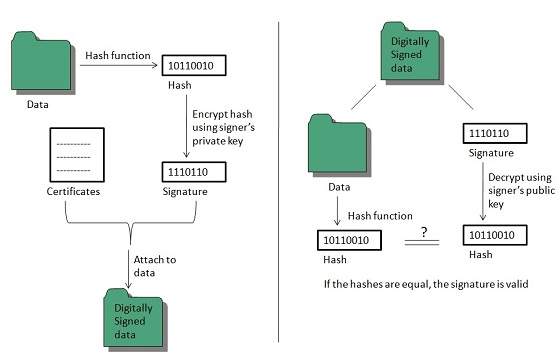
internet_technologies_tutorial
A digital signature should not only be tied to the signing user, but also to the message.

Applications

There are several reasons to implement digital signatures to communications:

Authentication

Digital signatures help to authenticate the sources of messages. For example, if a bank’s branch office sends a message to central office, requesting for change in balance of an account. If the central office could not authenticate that message is sent from an authorized source, acting of such request could be a grave mistake.

Integrity

Once the message is signed, any change in the message would invalidate the signature.

Non-repudiation

By this property, any entity that has signed some information cannot at a later time deny having signed it.

Comments

Popular posts from this blog

Principle security There are five principles of security. They are as follows: ·  Confidentiality: The principle of confidentiality specifies that only the sender and the intended recipient should be able to access the content of the message.               Integrity: The confidential information sent by A to B which is accessed by C without the permission or knowledge of A and B.   ·  Authentication: Authentication mechanism helps in establishing proof of identification. ·  Non-repudiation: ·  Access control: Access control specifies and control who can access what. ·  Availability: It means that assets are accessible to authorized parties at appropriate times. Attacks We want our security system to make sure that no data are disclosed to unauthorized parties. Data should not be modified in illegitimate ways   Legitimate user can access the data ...

internet security

Introduction Internet security refers to securing communication over the internet. It includes specific security protocols such as: Internet Security Protocol (IPSec) Secure Socket Layer (SSL) Internet Security Protocol (IPSec) It consists of a set of protocols designed by Internet Engineering Task Force (IETF). It provides security at network level and helps to create authenticated and confidential packets for IP layer. Secure Socket Layer (SSL) It is a security protocol developed by Netscape Communications Corporation. ). It provides security at transport layer. It addresses the following security issues: Privacy Integrity Authentication Threats Internet security threats impact the network, data security and other internet connected systems. Cyber criminals have evolved several techniques to threat privacy and integrity of bank accounts, businesses, and organizations. Following are some of the internet security threats: Mobile worms Malware ...

Firewell security

Firewall  is a barrier between Local Area Network (LAN) and the Internet. It allows keeping private resources confidential and minimizes the security risks. It controls network traffic, in both directions. The following diagram depicts a sample firewall between LAN and the internet. The connection between the two is the point of vulnerability. Both hardware and the software can be used at this point to filter network traffic. There are two types of Firewall system: One works by using filters at the network layer and the other works by using proxy servers at the user, application, or network layer. Key Points Firewall management must be addressed by both system managers and the network managers. The amount of filtering a firewall varies. For the same firewall, the amount of filtering may be different in different directions.