
Firewell security

Firewall is a barrier between Local Area Network (LAN) and the Internet. It allows keeping private resources confidential and minimizes the security risks. It controls network traffic, in both directions.
The following diagram depicts a sample firewall between LAN and the internet. The connection between the two is the point of vulnerability. Both hardware and the software can be used at this point to filter network traffic.
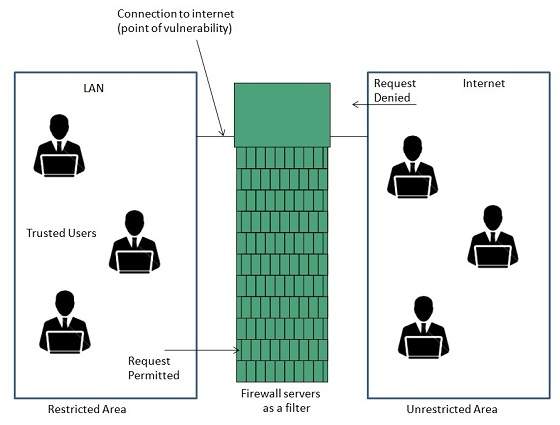
internet_technologies_tutorial
There are two types of Firewall system: One works by using filters at the network layer and the other works by using proxy servers at the user, application, or network layer.
Key Points
  • Firewall management must be addressed by both system managers and the network managers.
  • The amount of filtering a firewall varies. For the same firewall, the amount of filtering may be different in different directions.

Comments

Popular posts from this blog

Principle security There are five principles of security. They are as follows: ·  Confidentiality: The principle of confidentiality specifies that only the sender and the intended recipient should be able to access the content of the message.               Integrity: The confidential information sent by A to B which is accessed by C without the permission or knowledge of A and B.   ·  Authentication: Authentication mechanism helps in establishing proof of identification. ·  Non-repudiation: ·  Access control: Access control specifies and control who can access what. ·  Availability: It means that assets are accessible to authorized parties at appropriate times. Attacks We want our security system to make sure that no data are disclosed to unauthorized parties. Data should not be modified in illegitimate ways   Legitimate user can access the data ...

Essentials of information security

The security problem in computing   T he meaning of computer security The meaning of the term computer security has evolved in recent years. Before the problem of data security became widely publicized in the media, most people’s idea of computer security focused on the physical machine. Traditionally, computer facilities have been physically protected for three reasons:  • To prevent theft of or damage to the hardware • To prevent theft of or damage to the information • To prevent disruption of service Computer security is security applied to computing devices such as computers and smartphones, as well as computer networks such as private and public networks, including the whole Internet. The field covers all the processes and mechanisms by which digital equipment, information and services are protected from unintended or unauthorized access, change or destruction, and are of growing importance in line with the increasing reliance on computer systems of most soc...

THE DATA ENCRYPTION STANDARD

 THE DATA ENCRYPTION STANDARD The Data Encryption Standard (DES), a system developed for the U.S. government, was intended for use by the general public. It has been officially accepted as a cryptographic standard both in the United States and abroad. The DES algorithm is a careful and complex combination of two fundamental building blocks of encryption: substitution and transposition. The algorithm derives its strength from repeated application of these two techniques, one on top of the other, for a total of 16 cycles. The sheer complexity of tracing a single bit through 16 iterations of substitutions and  transpositions has so far stopped researchers in the public from identifying more than a handful of general properties of the algorithm. The algorithm begins by encrypting the plaintext as blocks of 64 bits. The key is 64 bits long, but in fact it can be any 56-bit number. (The extra 8 bits are often used as check digits and do not affect encryption in normal i...