
data encryption

Introduction

Encryption is a security method in which information is encoded in such a way that only authorized user can read it. It uses encryption algorithm to generate ciphertext that can only be read if decrypted.

Types of Encryption

There are two types of encryptions schemes as listed below:
  • Symmetric Key encryption
  • Public Key encryption

SYMMETRIC KEY ENCRYPTION

Symmetric key encryption algorithm uses same cryptographic keys for both encryption and decryption of cipher text.
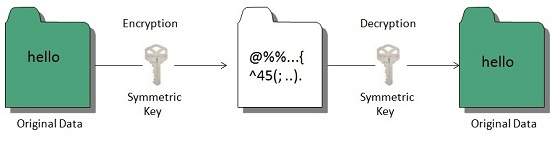
internet_technologies_tutorial

PUBLIC KEY ENCRYPTION

Public key encryption algorithm uses pair of keys, one of which is a secret key and one of which is public. These two keys are mathematically linked with each other.
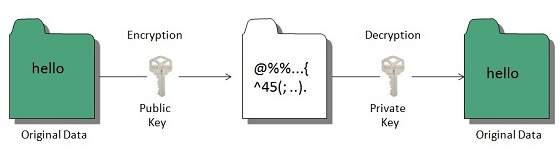
internet_technologies_tutorial

Hashing

In terms of security, hashing is a technique used to encrypt data and generate unpredictable hash values. It is the hash function that generates the hash code, which helps to protect the security of transmission from unauthorized users.

Hash function algorithms

Hashing algorithm provides a way to verify that the message received is the same as the message sent. It can take a plain text message as input and then computes a value based on that message.
Key Points
  • The length of computed value is much shorter than the original message.
  • It is possible that different plain text messages could generate the same value.
Here we will discuss a sample hashing algorithm in which we will multiply the number of a’s, e’s and h’s in the message and will then add the number of o’s to this value.
For example, the message is “ the combination to the safe is two, seven, thirty-five”. The hash of this message, using our simple hashing algorithm is as follows:
2 x 6 x 3 ) + 4 = 40
The hash of this message is sent to John with cipher text. After he decrypts the message, he computes its hash value using the agreed upon hashing algorithm. If the hash value sent by Bob doesn’t match the hash value of decrypted message, John will know that the message has been altered.
For example, John received a hash value of 17 and decrypted a message Bob has sent as “You are being followed, use backroads, hurry”
He could conclude the message had been altered, this is because the hash value of the message he received is:
(3x4x1)+4 = 16
This is different from then value 17 that Bob sent.

Comments

Popular posts from this blog

Principle security There are five principles of security. They are as follows: ·  Confidentiality: The principle of confidentiality specifies that only the sender and the intended recipient should be able to access the content of the message.               Integrity: The confidential information sent by A to B which is accessed by C without the permission or knowledge of A and B.   ·  Authentication: Authentication mechanism helps in establishing proof of identification. ·  Non-repudiation: ·  Access control: Access control specifies and control who can access what. ·  Availability: It means that assets are accessible to authorized parties at appropriate times. Attacks We want our security system to make sure that no data are disclosed to unauthorized parties. Data should not be modified in illegitimate ways   Legitimate user can access the data ...

internet security

Introduction Internet security refers to securing communication over the internet. It includes specific security protocols such as: Internet Security Protocol (IPSec) Secure Socket Layer (SSL) Internet Security Protocol (IPSec) It consists of a set of protocols designed by Internet Engineering Task Force (IETF). It provides security at network level and helps to create authenticated and confidential packets for IP layer. Secure Socket Layer (SSL) It is a security protocol developed by Netscape Communications Corporation. ). It provides security at transport layer. It addresses the following security issues: Privacy Integrity Authentication Threats Internet security threats impact the network, data security and other internet connected systems. Cyber criminals have evolved several techniques to threat privacy and integrity of bank accounts, businesses, and organizations. Following are some of the internet security threats: Mobile worms Malware ...

Firewell security

Firewall  is a barrier between Local Area Network (LAN) and the Internet. It allows keeping private resources confidential and minimizes the security risks. It controls network traffic, in both directions. The following diagram depicts a sample firewall between LAN and the internet. The connection between the two is the point of vulnerability. Both hardware and the software can be used at this point to filter network traffic. There are two types of Firewall system: One works by using filters at the network layer and the other works by using proxy servers at the user, application, or network layer. Key Points Firewall management must be addressed by both system managers and the network managers. The amount of filtering a firewall varies. For the same firewall, the amount of filtering may be different in different directions.